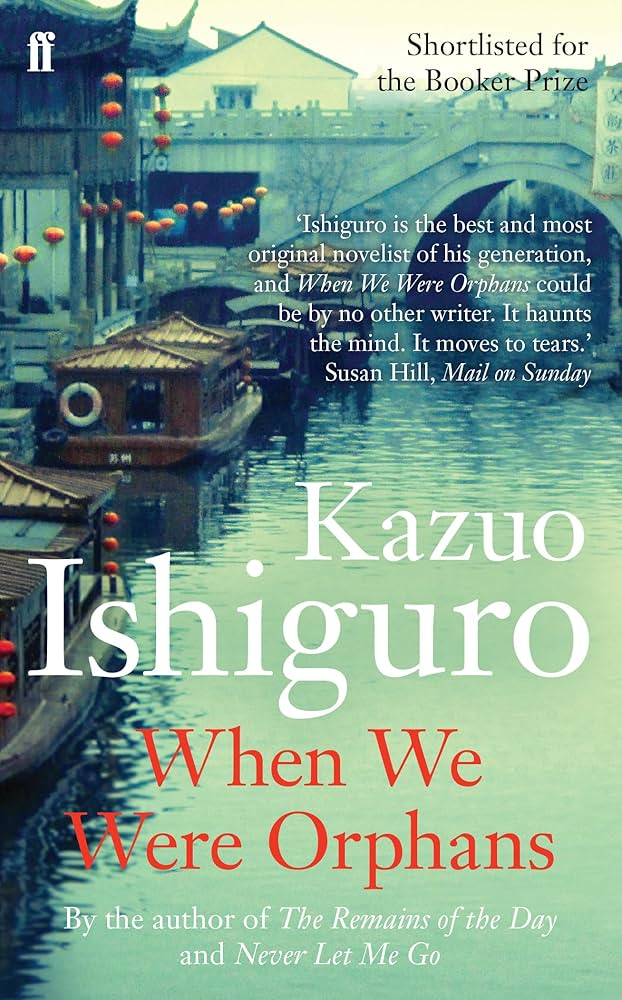
_Book information
Title: When We Were Orphans
Author: Kazuo Ishiguro
Genre: Psychological fiction
Published: 2000
Reading period: February 2026
_My interpretation
My first impression during the first half of the novel were of the unreliable narrator. When recalling his memories he
is often confused on why people perceive him in a certain way, for example - how his old school mates managed to
figure out his ambitions as a detective, to which he insists he was supposedly subtle about. The key part is, he is
often clearly in denial about what is evidently visible and out in the open and choses to downplay or ignore.
The narrator is an upcoming British detective, who was left an orphan after the disappearance of his expatriate
parents in Shanghai. After which he moves back to England and undergoes an upper class upbringing. His ambitions
derive from the call to “root out single handedly all the evil in the world”. After going over his memories, he
decides to confront one said evil by heading back to solve his parent’s disappearance in the midst of the Battle of
Shanghai, 1937. It is heavily implied by Christopher that his parent’s resistance to the British opium trade in China
had something to do with their disappearance.
Japanese expansion into China was already a medium term trend by the Second Sino-Japanese War, benefiting from a
nation weakened by British economic imperialism in the form of said opium trade and subsequent opium wars. From the
First Sino Japanese War, Japan’s economic interests in China only grew as a means to fuel their expansionist
ambitions. Jarringly, the plight of the Shanghainese inflicted by an imperialist war does not seem to concern
Christopher who is hyper focused on finding his parents, who he surmises are still held in some Shanghai house waiting
to be reunited. His delusion and removal from reality becomes clear.
“What has quietly shocked me, from the moment of my arrival, is the refusal of everyone here to acknowledge their
drastic culpability. During this fortnight I have been here, throughout all my dealings with these citizens, high or
low, I have not witnessed—not once—anything that could pass for honest shame. Here, in other words, at the heart of
the maelstrom threatening to suck in the whole of the civilised world, is a pathetic conspiracy of denial”
On the surface, this rant is towards the uselessness of the foreign community in Shanghai helping him solve the case.
On a deeper level, this is Christopher subconsciously becoming aware of their contribution towards the entire
political situation as a whole. Unfettered imperialist expansion under the guise of nation/economic strengthening -
brushed aside or even endorsed by the small man - predictably precedes the rise in world tensions. We see this
prologue of WW2 begins in the Chinese theatre, while expats adopt a carefree attitude of what is enveloping them –
watching on battles as if they are movies, showing no emotion towards war refugees. Almost as if unwilling to face the
degrading situation as the first major city in China officially falls to imperialist forces; Forces also responsible
for their presence in China.
Ishiguro makes it more and more difficult to ignore the very real political maelstrom outside of Banks’s detective
fantasy. Sir Cecil, admired statesman from the League of Nations and Wang Ku, respected detective once assigned to his
parent’s case turns out to be an opium addict. Everywhere debauchery and rot seep in – Banks’s denial cannot carry him
any longer, and he comes to a sort of enlightenment.
It is revealed that his father ran off with his mistress and his mother has been forced into concubinage by warlord Wu
Kang she came into contact with as a part of anti-opium campaign, with insidious intentions to profit off the opium
trade.
The truth of what happens to Banks’s parents - the dismal fate that befalls them – mirrors the impact of colonialism
in general told through British and Japanese imperialism. Banks’s insistence on sticking with his absurd fantastical
theory is a form of pure denial reminiscent to those from certain regimes of their role in the destruction of nations.
At the end, he is forced to reckon with the truth when both converge.
“The evil ones are much too cunning for your ordinary decent citizen. They’ll run rings around him, corrupt him,
turn him against his fellows”
Evidently by the end we know his mother did not remain devoted to their anti-opium campaign. She chooses to prioritise
Christopher, making an arrangement with the warlord to use the trade’s profits to fund her son. It is not really a
‘choice’ per say, as under Wu and later Chiang, their fight to control the opium trade becomes futile, to the point it
would be less painful to at least make use of its profits in the ‘financial arrangement’ for Christopher. This is how
he is able to live is comfortable life back in England. Thus the pushback one receives when up against “evil” results
only in concession or defeat. It is a system where hyper prioritisation of profit and greed allows evil to reign.
Where we are all too happy to turn away and close our eyes if it means getting our bread and circus, at the plight of
others.